Your "Senior Full-Stack Engineer" just became your interim Head of Product. Your "Marketing Manager" is now running customer success three days a week. And that person you hired as a "Growth Hacker"? Nobody's quite sure what they do anymore, but everyone agrees they're essential.
Welcome to startup life, where job titles have the shelf life of milk.
Here's the problem: your entire talent strategy is probably built around those titles. Your org chart. Your succession planning. Your hiring pipeline. Your compensation bands. All structured around roles that will be completely different six months from now. And when everything shifts—when you pivot, scale, reorganize, or adapt to survive—you're left scrambling to figure out who can actually do what.
The Title Trap
Let me tell you about a conversation I had last month with a startup CEO. Series B. Growing fast and panicking quietly.
"We need to hire a VP of Sales," she told me.
"Why?" I asked.
"Because our Director of Sales is overwhelmed and we need someone more senior."
"What does your Director of Sales actually do?"
Long pause.
"Honestly? A lot of customer success work because that team is understaffed. Some product feedback because she understands our users better than anyone. And yes, some sales. But mostly she's putting out fires."
"So you don't need a VP of Sales. You need to understand what skills your team actually has, where the gaps are, and how to deploy people based on capabilities rather than titles."
Another long pause.
"We have no idea how to do that."
She's not alone. Most startups don't.
Why Titles Fail in High-Growth Environments
Here's what happens in a traditional organization:
You hire someone for a specific role. They do that role. Maybe they get promoted. Maybe they switch to another specific role. The system is stable because the roles themselves are stable.
Now here's what actually happens in startups. You hire someone for a role that will evolve three times before their first anniversary. They'll take on responsibilities that don't exist yet. They'll stop doing things that become irrelevant. They'll discover skills they didn't know they had and use skills that weren't in the job description.
Six months in, their title is a historical artifact—a snapshot of what you thought you needed when you hired them, not a reflection of what they actually do or what they're capable of doing. And this isn't a bug. It's a feature. Startups that can't adapt die. People who can't wear multiple hats don't survive. The flexibility is the point.
But here's the catch: if your talent management system is built on titles, you're flying blind.
What Skills-Based Mapping Actually Means
Let's get specific. When I talk about mapping competencies instead of titles, here's what I mean:
Instead of knowing:
- "We have 3 engineers, 2 product managers, 1 designer"
You know:
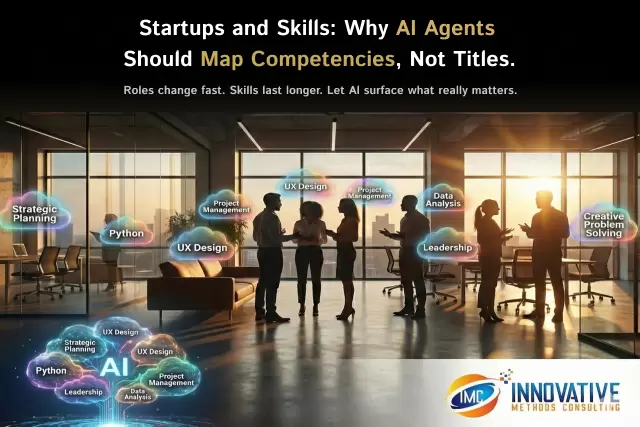
- "We have 6 people with React skills at varying levels."
- "4 people with customer interview experience."
- "2 people who can do data analysis."
- "3 people with B2B sales experience"
- "1 person who actually understands our API documentation."
See the difference?
The first tells you what people's business cards say. The second tells you what your team can actually do.
And here's where it gets interesting: you probably have skills scattered across your team that you don't even know exist. Your engineer who worked in consulting before joining you? They can facilitate client conversations better than most of your customer success team. Your designer who freelanced for years? They understand pricing and contracts better than your Head of Operations. Your customer success person who taught high school? They can train new hires better than anyone. These capabilities are invisible in a title-based system. They're gold in a skills-based one.
Why AI Agents Change Everything
Now, you might be thinking: "Great idea, but I barely have time to keep the lights on. How am I supposed to track every skill for every person manually?" You're not. That's the whole point. This is precisely the kind of problem AI agents were built to solve.
Here's how it works in practice:
Continuous Skills Discovery AI agents can analyze what people actually do—not what their job description says they should do. They look at:
- Projects they've worked on
- Tools they use regularly
- Documents they've created
- Problems they've solved
- Skills they've demonstrated in real work
Dynamic Skill Mapping. Instead of annual reviews where someone asks, "What are you good at?" and people shrug, AI agents build living skill profiles that update continuously. When your engineer fixes a critical production issue at 2 AM, that incident response capability gets mapped. When your product manager facilitates a tough stakeholder negotiation, that conflict resolution skill gets noted.
Gap Analysis That Actually Helps. When you're planning your next product launch, hiring for a new role, or trying to figure out who should lead a critical project, AI agents can tell you:
- What skills you have on the team
- Where your critical gaps are
- Who has adjacent skills that could develop
- Whether you actually need to hire or if you can redeploy
Intelligent Redeployment. This is where it gets really powerful. When priorities shift (and they constantly shift), AI agents can suggest: "Based on skill overlap, Sarah from marketing could cover 60% of what you need in customer success while you hire. Here's what she'd need to learn and who could train her."
A Real-World Example
Let me show you what this looks like in practice.
A fintech startup I worked with was about to post a job for a "Compliance Manager" because regulations were getting complex, and their Head of Legal was drowning. Before posting, we worked with them to map their team's actual skill inventory—the kind of deep capability analysis that AI agents are positioned to automate.
The process surfaced something surprising: their Senior Product Manager had spent two years at a regulatory agency before joining the startup. That experience never came up in interviews or onboarding. It wasn't on his LinkedIn. But it was evident in how he approached product documentation and the questions he asked about data handling. They moved him into a hybrid role—50% product, 50% compliance infrastructure. He was thrilled (turned out he missed that work). They saved six months of hiring and onboarding. And they got someone who understood both the regulatory requirements and how their product actually worked. That never happens in a title-based system. That person is a "Product Manager" forever, and his regulatory expertise stays hidden.
The Organizational Benefits
Once you start thinking in skills rather than titles, everything changes:
Hiring Gets Smarter. Instead of posting for a "VP of Marketing," you can say: "We need someone with B2B content strategy, growth experimentation, and team leadership. We can teach them our market." You hire for capabilities and adaptability, not credentials.
Internal Mobility Gets Real. When someone says, "I'm interested in doing something different," you don't have to guess whether they're qualified. You can see what skills they have, what's adjacent, and create a development path that actually makes sense.
Succession Planning Becomes Possible In a startup, "succession planning" usually means "pray that nobody critical quits." With skills mapping, you can identify where you're one person deep on critical capabilities and do something about it before it becomes a crisis.
Resource Allocation Gets Flexible. When a customer emergency hits or a strategic opportunity opens, you can quickly identify who has the skills to help—even if it's not "their job."
Development Becomes Targeted Instead of generic "professional development," you can invest in specific skills that fill fundamental gaps and open up new possibilities for both the individual and the company.
The Arguments Against (And Why They're Wrong)
Whenever I talk about this, I hear the same objections:
"Our team is too small to need this."
Wrong direction. Small teams need this more. When you've got 8 people doing the work of 20, knowing exactly what everyone can do is the difference between surviving and drowning.
"It's too complicated to implement."
It's actually less complicated than what you're doing now. You're already tracking titles, roles, and responsibilities in your head. You're just doing it inefficiently, inconsistently, and with huge blind spots.
"People don't want to be reduced to a list of skills."
Skills mapping isn't reducing people—it's revealing their full capability. Most people in startups are frustrated because they have skills they can't use. This makes those skills visible and valuable.
"We can't afford the technology."
You can't afford not to. The cost of a bad hire, a missed opportunity because you didn't know someone could handle it, or a key person leaving because they felt pigeonholed—those costs are massive.
What This Looks Like in Practice
Let's make this concrete. Here's what skills-based talent management looks like day-to-day:
Monday Morning: Your Head of Sales mentions they're overwhelmed with onboarding new customers. Your AI agent suggests that your technical writer has customer training experience from their previous role and could develop onboarding materials. Problem solved.
Wednesday Afternoon: You're planning a new enterprise feature. Instead of assuming your enterprise account manager should lead it, your AI agent identifies that your newest engineer has enterprise software experience and has been asking for more strategic work. You pair them together. Better solution, better engagement.
Friday: Someone on your team expresses interest in a different role. Instead of "let's see what opens up," you can have an honest conversation about skill development: "Here are the 3 skills you'd need to develop. Here are 2 upcoming projects you could build. Let's create a 6-month plan."
This isn't theoretical. This is what becomes possible when you know what your team can actually do.
The Competitive Advantage
Here's the bottom line: in a startup environment where adaptability is survival, the companies that win are the ones that can:
- Redeploy talent quickly when priorities shift
- Identify hidden capabilities within their team
- Make more intelligent hiring decisions based on actual needs
- Develop people in ways that serve both individual growth and company needs
- Avoid the "key person risk" problem by knowing who else can do what
All of that requires knowing what skills you have, not just what titles people hold. Your competitors are still organizing around job descriptions written six months ago. They're still hiring for roles that will be obsolete by the time someone starts. They're still losing people because they can't see what those people are capable of beyond their current title.
You don't have to do that.
Where to Start
If you're reading this thinking, "okay, but how do I actually do this?" here's your starting point:
This Week: Stop thinking about your team as a collection of job titles. Start thinking about them as a portfolio of capabilities. Ask yourself: "If I could only describe what my team can do rather than what their titles are, what would that list look like?"
This Month: Talk to your team about their complete skill sets—including things they did before joining you, side projects, previous careers, and education. You'll be surprised by what you find.
This Quarter: Implement an AI agent system that can actually track, analyze, and surface skills across your organization, not as a "nice to have," but as critical infrastructure for how you manage talent.
The startups that figure this out early—that build their talent strategy around skills rather than titles—are the ones that will scale efficiently, adapt quickly, and retain their best people. Those who stay stuck in title-based thinking will keep wondering why they can't move as fast as they need to.
The Real Question
Your roles will change. Your org chart will be redrawn. Your strategy will pivot.
But your team's skills? Those are your actual assets. Those are what build products, solve problems, serve customers, and create value. So here's the question: Do you know what your team can actually do? Not what their titles say. Not what you hired them to do. But what they're actually capable of doing right now?
If the answer is no—or even "sort of"—it's time to let AI agents surface what really matters. Because in the startup game, the companies that know what they're working with beat the ones that are still guessing—every time.
What has been your experience with building a talent strategy around skills and competencies rather than titles? Contact us - we would love to know how it is working for you.